
The Mountain Ear - August 2026
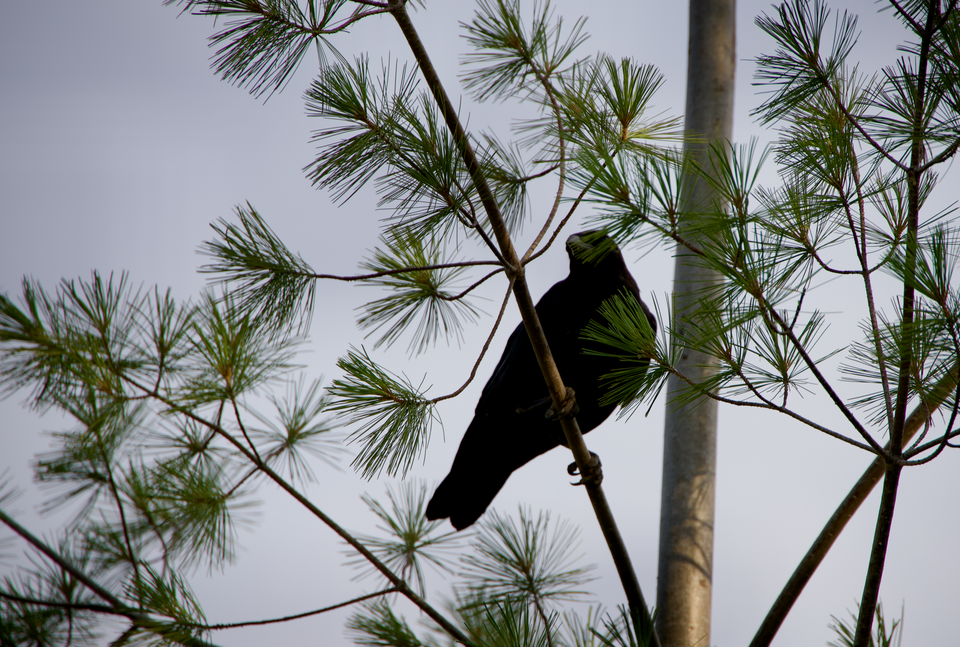
I didn't know it was a conspiracy when I saw the first raven flying west, passing in front of me as I drove north on US93 in eastern Nevada. Not long after, another raven flew across the highway on the same heading. Then another, and another, and another. Never more than a minute or two between birds, always one bird at a time, always seeming intent on the same destination. This went on for more than an hour, totaling hundreds of ravens.
Ravens are not migratory, so the behavior was perplexing. I have described this experience to a couple of ornithologists that I know, and neither one had an explanation. All they could come up with was that we know ravens communicate with one another, so whatever it was they were flying towards, they had presumably learned about it from other ravens. How this news was communicated across an area spanning hundreds of square miles, I have no idea.
My friend Greg is a glider pilot and has described to me the experience of riding the thermals up to high elevations and finding himself in the company of ravens, eagles, and other birds. They're up there for the same reason he is: to play. Ravens can recognize human faces and are even able to describe these faces with enough fidelity that other ravens can identify a particular human without ever having encountered that individual before. I don't know what sorts of thoughts ravens are capable of, but I have wondered if they look upon humans with the same sense of superiority that most humans look upon other animals. Humans are incapable of flight, so we are relegated to building flying machines. Humans are so fragile that we can't survive outdoors, so we have to build shelters to dwell in. And as if to accentuate just how delicate we really are, we then attach machines to those shelters to alter the temperature.
In Suzanne Simard's brilliant memoir, Finding the Mother Tree, she describes how trees in a forest communicate with one another using chemical signals. These signals are transmitted by the mycelium of fungi, and the chemicals are the very same neurotransmitters used in human brains. This network acts in ways that are more similar than different to a human nervous system. The trees know which individuals are their kin and use this network to actively nurture the young trees of their own family.
If trees are aware which individuals are related to them, it begs the question: are they conscious? Michael Pollan examines this question as part of his broader exploration of what consciousness actually is in his brilliant book, A World Appears. He describes mimosa pudica, also known as the sensitive plant, a member of the legume family whose leaves curl up when touched. They will uncurl minutes later when no longer being touched. Not only are these plants aware they are being touched, they can learn not to respond to a false stimulus, such as being placed on a table that is shaken. Studies have shown that they not only learn, but remember what they have learned. Are learning and memory possible without some degree of awareness and reasoning?
Neuroscientist and mindfulness teacher Sam Harris posits that at its core, consciousness is simply awareness. Let's suppose, then, that plants are conscious. And while it seems unlikely that they have thoughts analogous to ours, let's imagine they do. Trees live for hundreds and even thousands of years and have been evolving for millions of years longer than humans have. Trees eat sunlight and emit oxygen as a by-product. They hold soil in place and give back to the ecosystem by providing food and shelter to the animals with whom they share space. What might such highly evolved beings think about humans? Probably that we consume wastefully by taking more than we need. That we extract from our environment without replacing what we have taken. That we think we are somehow more special or important than the other species with whom we share a home simply because we are an apex predator that has learned to be particularly adept at making and using tools.
I acknowledge that suggesting birds and trees might be capable of thought sufficient to have opinions about humans is pretty woo-woo. I'm fine with that. The longer I live, the less certain I have become of anything and the more comfortable I have become with not knowing. Not knowing opens the door of discovery. Nearly every major advance in human knowledge was viewed as woo-woo or heretical based on the wisdom of the day. I am OK with saying I don't know or being called woo-woo if it leads to learning and growth.
These non-human perspectives I have imagined present an unflattering view of much human behavior, and for valid reasons. But humans also create music, poetry, and art. We show empathy and compassion. We heal injury and disease and care for those afflicted throughout that process. We push ourselves to try difficult things just to see if they can be done. We exhibit curiosity and yearn to explore. But for all that our incredible human minds have learned to say, do, and create, we remain slow to learn (and to be clear, I mean that I am slow to learn) not to say and do insensitive and inconsiderate things to others, including those we care about the most. We all possess a unique blend of remarkable features, and we all possess a more or less comparable measure of flaws. Of all these features, though, the one I consider most remarkable is the ability to unconditionally love someone else, in spite of their flaws.
Go outside and be kind.
-Mark
22nd Annual Kercher Glacier Classic
As of today, club members have started to converge upon the Divide Creek Campground for this year's edition of the Kercher Glacier Classic. It is the signature event of the Rocky Mountaineers that brings together some amazing humans in one of the most magical places in the world. One of the challenges I face each year is deciding which hikes to do. On the one hand, I want to explore places that I haven't yet been. On the other hand, I want to revisit favorites from years past. It's a good problem to have.
While the collective gathering is what makes this event special, it wouldn't happen without the passion and effort of Forest Dean. This event is a labor of love for Forest, and he puts in a tremendous amount of time behind the scenes planning, coordinating, and generally ensuring that everyone who participates has a place to stay and something to do while they're there. While Forest is as generous towards and committed to the Rocky Mountaineers as anyone has ever been, it seems that some of his motivation around this event in particular is to honor the memory of his late friend, Bryan, as is evidenced by the following paragraph that Forest wrote describing the event:
In 2021 the Glacier Classic was renamed the Kercher Glacier Classic in honor of our dear friend and club member Bryan Kercher. Bryan tragically lost his life in a mountaineering accident in the spring of 2021. He loved Glacier National Park as much or more than anyone we ever knew. What better way to celebrate his contagious smile, energy, and spirit than to share some adventures in this magnificent place?
If you won't be there, we wish you were, and we hope you will make plans to join us next year. In the immortal words of Warren Miller, if you don't, you'll only be another year older when you do.
Achievement Awards
Each September, at the first of our fall-through-spring monthly meetings, we recognize club members who have completed any of the groupings of mountain summits noted on our website. If you have (or will have) completed one or more of these by September 8, please let us know so that you can be recognized.
We would also like to recognize Rocky Mountaineers whose service to the club or to our outdoor community at large has been noteworthy. If you would like to nominate someone for special recognition, please send a message or contact one of the officers directly.
Rocky Mountaineers Book Club
Starting this fall, we're kicking off something new for the Rocky Mountaineers, a book club! Since we're an outdoor club, we'll be reading books with an outdoor theme of some sort, the first of which will be The Monkeywrench Gang by Edward Abbey. Our first meeting will be Wednesday, 25 September. We will meet at Mark's house unless interest exceeds available space, so please RSVP if you'd like to participate.
TRM Gear Closet
Our exclusive for members Gear Closet continues to grow. This gear is for you to use at no charge. If you’d like to check something out, send an email with subject Gear Closet.
A complete listing of all the gear we currently have available can be found on our website.
Upcoming Trips and Activities
Rattlesnake Summit Series - various dates, see calendar - Rattlesnake Range
Kercher Glacier Classic - 27-30 August - Divide Creek Campground
Trail Work Weekend - 10-13 September - Great Burn Wilderness
Please visit our event calendar for details on these and other outings!
TRM Merchandise
We have merchandise available for purchase at our presentations, quarterly business meetings, and special events. Please contact Elizabeth at heyartemisoutside@gmail.com if you’d like to purchase something for local pickup.
 |  |  |
| Beanie $25 | Pint Glass $10 | Keychain $5 |
 |  |  |
| T-Shirt $20 | Trucker Hat $20 | Buff $5 |
Ongoing Call for Photos, Videos, and Presenters
If you have some photos or videos you'd like to share that we can use for social media, event promotion, sponsor videos and our newsletter please email Elizabeth or upload to this google photo/video link: https://photos.app.goo.gl/173AgLc4wrkYofvWA
If you are interested in presenting at a future Rocky Mountaineers monthly meeting or know of someone who would be, please contact Mark. We will begin filling our calendar for Fall 2026 soon.
Club Officers
President- Mark Albrecht
Vice President – Francis Horton
Secretary- Carson Ramsden
Treasurer- Tom Statz
Website- Kyle O'Connor
Archivist- Julie Kahl
Social Media and Video Production – Elizabeth Smith

Member discussion